The project ”Bridge of Good Governance” encourages billateral collaboration and the transfer of good practices between Romania and the Republic of Moldova by monitoring the degree of legislation implementation in priority areas such as access to information of public interest and administrative transparency.
The first step consisted of connecting the platforms romaniacurata.ro and moldovacurata.md.
Working together with experts of the Romanian Academic Society (which coordinates the Clean Romania platform), of the Advocacy Academy (promotor of Coalition 52) and the Association of Free Press from Chisinau (coordinator of the Clean Moldova platform), volunteers from both sides of the river Prut have worked on creating the means to monitor the way in which the freedom of information acts (Law 544/2001 – Romania and Law 982/2000 – Republic of Moldova) have been respected from the moment that institutions and state authorities have had the obligation to submit activity reports. Both the Romanian and Moldovan side used the same methodology.
It has been checked whether the annual activity reports are published in a visible part of the websites belonging to the verified institutions: ministries, county / raion councils, county / raion capital city halls. Similarly, research has been done into whether the content of said documents contains all of the information required by the law (both the quantity and the quality of the reports was verified).
The number of instituions and authorities whose activity reports have been checked = total 189
Romania = 106, of which 18 ministries, 41 county councils and 47 city halls of county residences, including Bucharest and its 6 sectors.
The Republic of Moldova = 83, of which 16 ministries, 32 raion councils and 35 city halls of raion capitals, plus Chisinau.
For simplicity’s sake, the number of ministries was considered constant for the entire duration of the study.
Data gathering was done June and October 2015.
The maximum number of annual reports that had to be published =
14 for every institution among those monitored from Romania
12 for every institution among those monitored from the Rep. of Moldova.
Romania – 30%, Moldova 9,9%
*In total, the 106 monitored institutions from Romania were expected to publish, over a period of 14 years, 1484 reports. There are only 449 reports, which amounts to 30%. Of the published reports, only 227 (50,6% of the published total and 15,3% of the expected total), have followed legal requirements concerning the nature of their content.
*Starting with 2003, the 83 monitored institutions from the Republic of Moldova were supposed to publish 996 activity reports in accordance with the law. Only 99 have been published, which means that the general degree of law conformity is of 9,9% during the 12 years since Moldova has been administratively reorganized into 32 raions.
*Out of the total 2.480 activity reports which had to be made public by the monitored institutions in both Romania and Moldova, only 548 have actually been published. Romania and the Republic of Moldova have, therefore, a commmon percentage of law conformity of 22%, which shows just how much more progress both countries srill need to make in this area.
The List of Shame
Below are state institutions who keep their activity secret from public opinion (have not published a single report on their websites)
Romania :
The county councils of: Bacău, Brăila, Brașov, Constanța, Covasna, Neamț, Vrancea
The Ministries of: Culture, National Education, Energy, Small and Medium-sized Business and the Business Environment, Economy
The City Halls of: Alba-Iulia, Bucharest Sector 2, Bucharest Sector 5, Constanța, Drobeta-Turnu Severin, Miercurea Ciuc, Sfântu Gheorghe, Slatina, Târgoviște, Pitești, Tulcea and Vaslui.
The Republic of Moldova :
The Raion Councils of: Anenii Noi, Basarabeasca, Briceni, Cahul, Călărași, Cantemir, Căușeni, Cimislia, Criuleni, Dondușeni, Drochia, Dubăsari, Fălești, Florești, Glodeni, Ialoveni, Leova, Nisporeni, Ocnița, Orhei, Rășcani, Rezina, Sângerei, Soldănești, Soroca, Stefan Vodă, Strășeni, Taraclia, Telenești, Ungheni
The Ministries of: Foreign Affairs and European Integration
The City Halls of: Anenii Noi, Bălți, Primpria Basarabeasca, Briceni, Cahul, Cantemir, Căușeni, Comrat, Criuleni, Dondușeni, Drochia, Dubăsari, Edinet, Fălești, Glodeni, Hincești, Ialoveni, Nisporeni, Ocnița, Rașcani, Rezina, Sângerei, Soldănești, Strășeni, Taraclia, Telenești and Ungheni.
In some cases, certain institutions had no website at all (Rașcani City Council, Anenii Noi City Council, Briceni City Council, Dubăsari City Council, Florești Raion Council or Telenești Raion Council), and in other cases, the websites were in „technical pause” (Criuleni County Raion).
Joint top of instituions whose activity is transparently reflected in reports (at least 10 activity reports published on their site)
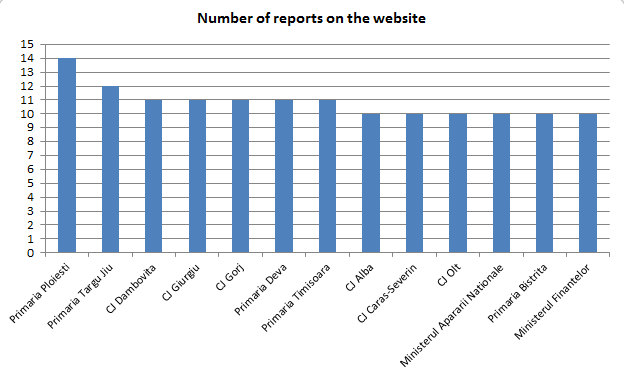
The only instituion from the Republic of Moldova that has published at least 10 activity reports is the Ministry of Finance.
Top institutions who respect the law concerning the content of activity reports
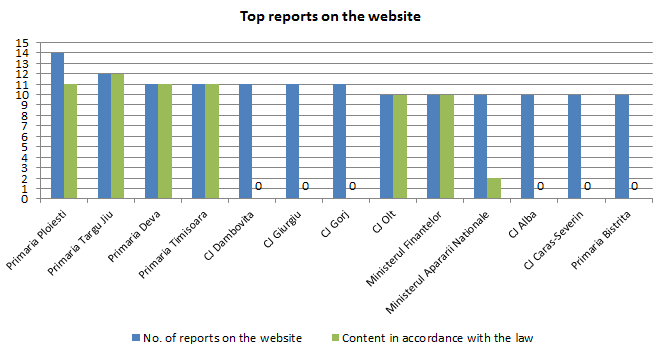
Only 6 institutions (3,2%) have at least 10 activity reports that respect the legal requirements concerning content. On the other hand, we have the institutions that have published more than 10 activity reports of which none has contents in agreement with the requirements of the law
Top institutions that do not respect the law concerning the content of activity reports
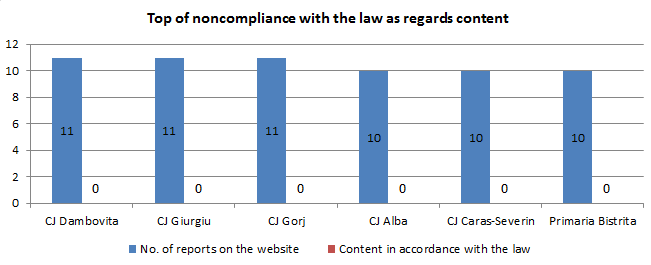
The general situation of institutions that have published at least 10 activity reports on their site and whose content does not respect legal norms (superficiality in the redacting process).
How poor is the quality
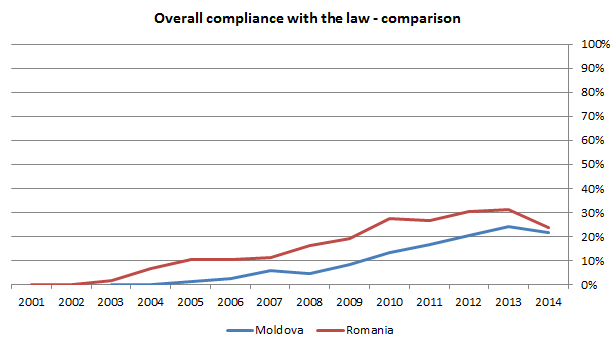
A yearly comparison of law conformity in Romania and the Republic of Moldova of the number of annual reports whose content respects legal norms, contrasted with the total number of reports that had to be published. Source: own calculations
Romania. Comparative perspective – quantitative analysis
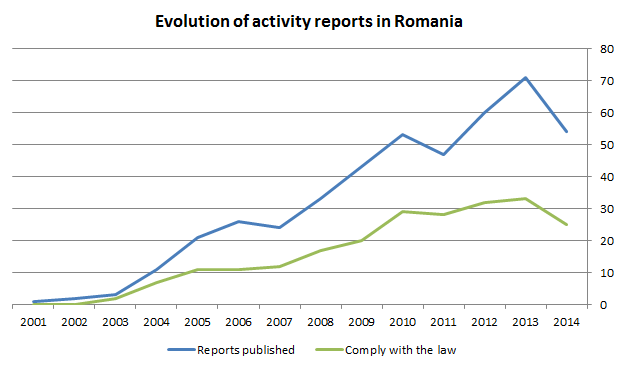
Yearly situation of the number of institutions out of the total of 106 that have published activity reports on their own websites and the conformity of these reports with the law
Yearly situation of the percentage of institutions out of the total of 106 that have published activity reports on their own websites and the conformity of these reports with the law
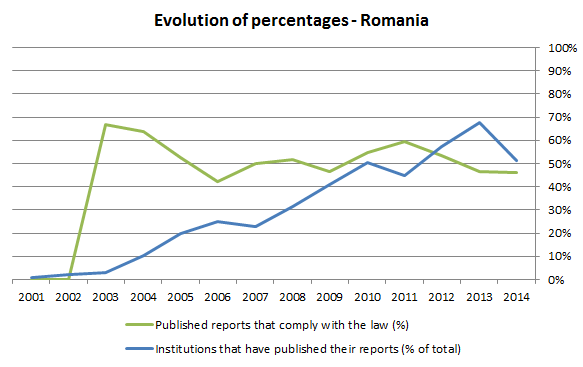
Republic of Moldova. Comparative perspective – quantitative analysis
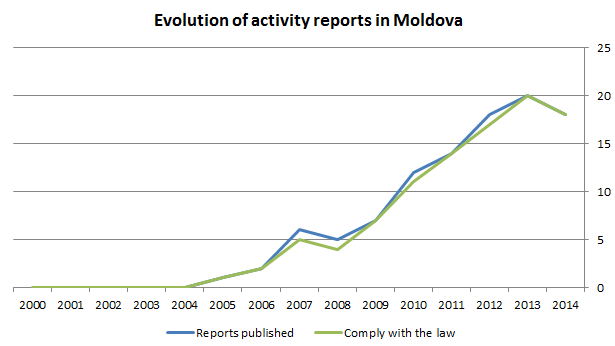
Yearly situation of the number of institutions out of the total of 86 that have published activity reports on their own websites and the conformity of these reports with the law
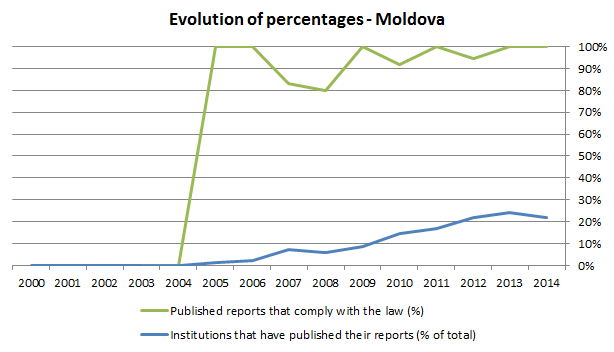
Yearly situation of the percentage of institutions out of the total of 83 that have published activity reports on their own websites and the conformity of these reports with the law*
Top report transparency – MINISTRIES
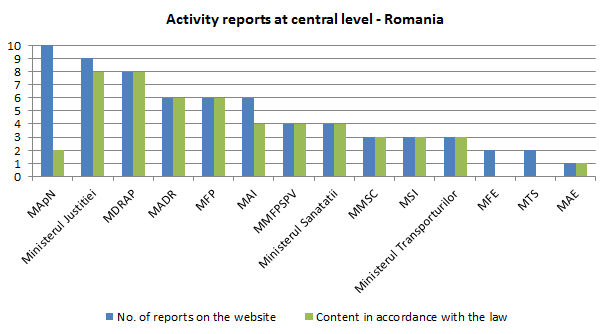
Situation of the number of activity reports that Romanian ministries have published on their websites and who have at least one report, and their conformity with the law: 77% of reports published by Romanian ministries respect the law
Top report transparency – COUNTY COUNCILS
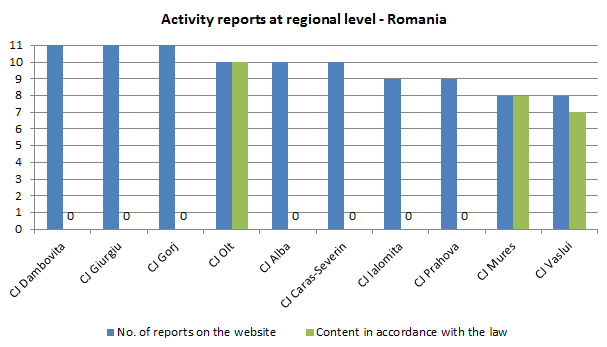
Top 10 of Romanian county councils judged by the number of activity reports published on their website and their conformity with the law
Top report transparency – CITY HALLS
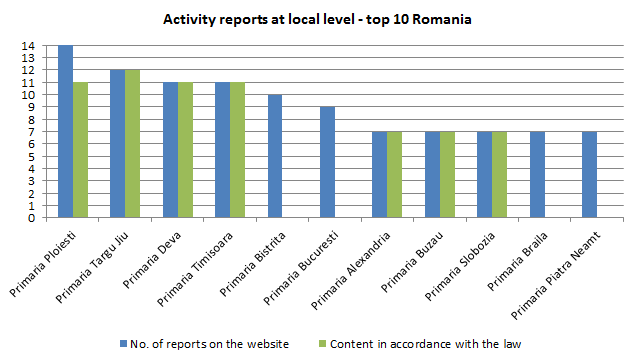
Top 10 of Romanian city halls judged by the number of activity reports published on their website and their conformity with the law
Major differences concerning transparency between the two countries visible at the local level
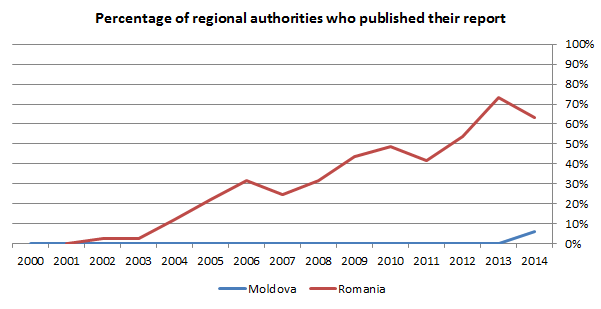
Yearly comparison of the percentage of county councils and raions from Romania and the Rep. of Moldova that have published activity reports on their own websites. Unlike the ministries of Moldova, that have become quite thorough concerning the publishing of activity reports, raional councils have almost no interest for the subject
CONCLUSIONS
Very slow progress when it comes to applying the law, a very high degree of disinterest toward the obligation of presenting public opinion with activities sponsored through public funds
*Major delays in publishing activity reports
*Major difficulties with respecting the freedom of information acts: the reports are not visible on the same place on the site, sometimes they are published under different names, they are hard to access (not in open format)
*Any person that wants to read the activity reports would require considerable amounts of time to find them in hidden sections
*There are no efficient mechanisms that can integrate transparency in the daily functioning of institutions
*There is no institutional memory, reports from ministries that have been disbanded or absorbed over the years cannot be found on any websites, they simply disappear
*Reports are published with considerable delays and intrerruptions; institution leaders have little focus on position chronology (they tend to report just about their time in office); conformity with the law is mostly an exception rather than the norm; institution leaders tend to praise themselves rather than report on the agency as a whole
*The reports lack any mentions of failed projects, performance indicators, proposals for fixing deficiencies and objectives.
RECOMMENDATIONS
Proposals from experts that have analysed all activity reports from the moment the reports came out, on the three institutional categories: ministries, county / raion councils and city / raion halls are:
*Setting precise deadlines for the publishing of activity reports from the previous year
*Increasing the overall spectre of information whose publication is compulsory
*Setting a standard format for the websites of public institutions, which will include certain mandatory sections, including the visible upload of activity reports
*Clarifying the exact name activity reports should have for every institutional category and setting up some clear and compulsory norms and sections (such as a contents page and numbered pages)
*Publishing information of public interest in machine-readable format, to allow for studies and research to be made without having to transcribe the data
*Setting the time period that an annual report must cover from, and including, January to December
*Both Romania and the Republic of Moldova must have publicly available statistics about compliance with the freedom of information acts, and clear norms to detail exactly what, how and when the information will be made public
*There needs to be a catalogue and an archive of all published activity reports, including those of institutions that no longer exist or have been assimilated, along with a history of all the institutional restructuring, in a format accessible to the broader public
*Integrating previous proposals in a more ample administrative reform program. Institutional design needs rethinking, so that transparency can be a part of the day to day functioning of institutions, not a separate component that is completementary to normal functioning, but is very often disregarded and ignored.
”Considering that, for example, Romania is second to last (27th), in the Index of Public Integrity (IPI) that was presented at the end of January by the Dutch Presidency of the EU, and the fact that the score also considers the indicator which assesses the level of transparency, we recommend that the government and the political class pay more attention to management quality.
This study strengthens the conviction that if we really want to lower the level of corruption, we need the entire political class to contribute to the urgent development and application of public policies that generate clear rules in order to make institutional transparency in both Romania and Moldova a well-established cultural norm” – Simona Popescu, project manager of the ”Bridge of good governance”.
*Observations: What should an activity report consist of
Romania
Annex Nr. 6 of the methodological norms of law 544/2001 highlights the fact that the activity report needs to contain the following information:
The mission of said authorithy or public institution, as well as the objectives that had to be met during the reporting period;
Performance indicators, with their degree of success also presented;
A short presentation of the programmes undergone and the manner in which they report to the objectives of the authorithy or public institution in cause;
Spending reports, independent of the programme;
Failed objectives, with the reasons for the failure presented (only where necessary);
Proposals for defficiency reduction.
The Republic of Moldova:
„With the aims to ensure the transparency of institutional activity, making access to information more efficient, creating conditions for the search and operative identification of documents and information, public authorities, public institutions will edit, at least once a year, a guide that will contain lists of all decisions and depositions, and other official documents, published by the institution in cause, and the domains in which information can be provided, will make available to representatives of means of mass information official dates about its own activity, including the domains in which information can be provided”.
The ”thinness” of law in the Rep. of Moldova explains the graph which refers to the evolution over time of percentages from this country which gives the impression of a very good quality.